
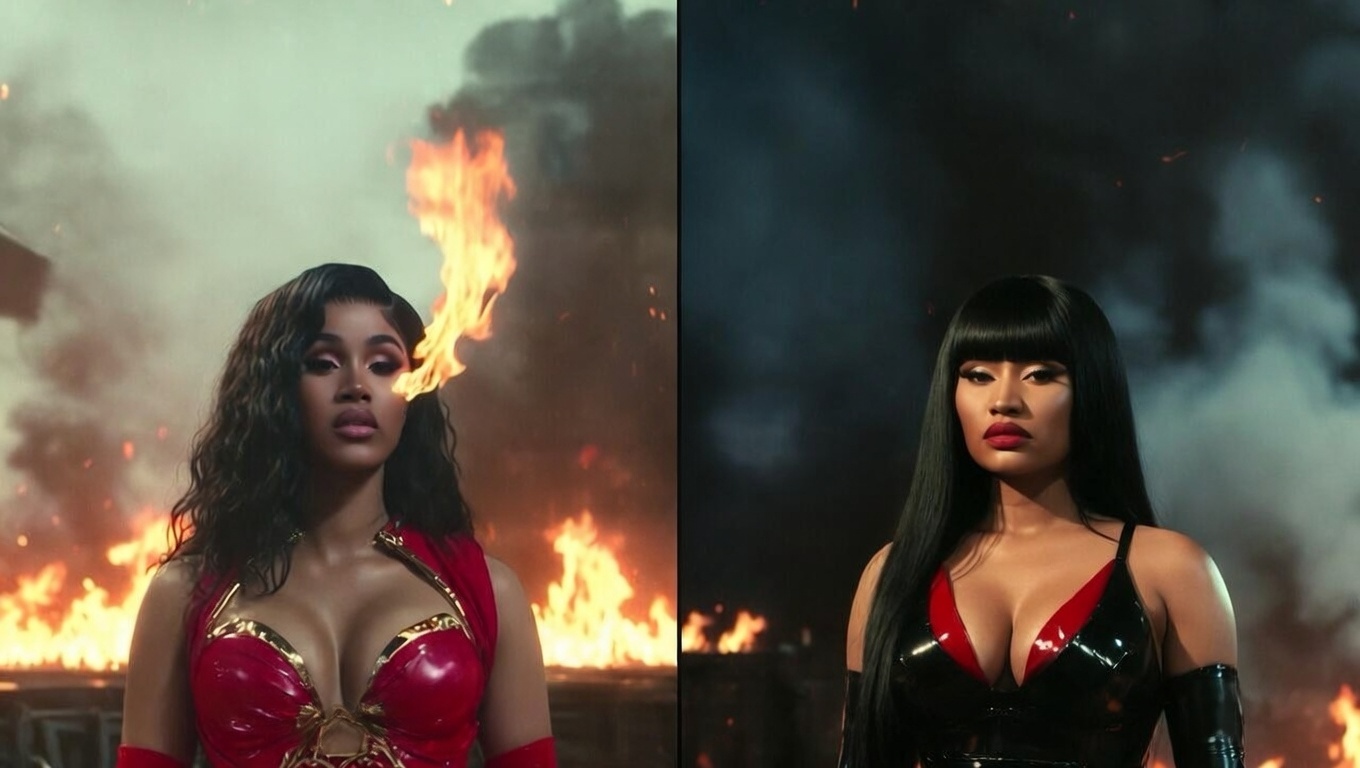
In the long and storied history of celebrity feuds, few have been as sustained, as layered, or as genuinely consequential for their industry as the ongoing conflict between Cardi B and Nicki Minaj. What began as competitive tension between two artists fighting for the same space in hip hop has evolved into something far more complex — a years-long narrative of clashes, ceasefires, subtweets, diss tracks, and public confrontations that has captivated the music world and divided fans into deeply committed camps.
To understand where things stand today, it helps to go back to the beginning. When Cardi B emerged as a genuine star in 2017, the music industry immediately framed her rise in relation to Nicki Minaj — a comparison that neither woman invited but both were forced to navigate. The positioning was inevitable given the overlap in their lanes, but the framing created a competitive dynamic that made genuine coexistence difficult and conflict almost structurally inevitable.
The first truly public explosion came at a New York Fashion Week event in 2018, when a confrontation resulted in Cardi attempting to throw a shoe — an incident that generated headlines globally and established for the public record that whatever tensions existed between the two women were real, raw, and not subject to the usual celebrity management of keeping disputes behind closed doors.

The musical dimension of the feud has been its most creatively productive element — at least for fans of both artists. The exchange of lyrical shots, coded references, and outright callouts has produced some of the most energized music either woman has released, with each perceived slight apparently serving as creative fuel for remarkable artistic output. Industry analysts have noted, somewhat wryly, that the feud has been commercially beneficial for both parties in ways that a genuine reconciliation might actually undermine.
What makes the conflict genuinely interesting from a cultural standpoint is what it reveals about the music industry’s enduring tendency to pit women against each other — to insist that there is only enough room at the top for one at a time, and to frame female competition as spectacle rather than examining the systemic pressures that create it. Both Cardi and Nicki have, at different moments, articulated this frustration with genuine clarity and force.
Sources close to both camps describe occasional back-channel communications — moments where the human reality of two people who respect each other’s talent, even while maintaining public conflict, briefly surfaces. Whether those moments ever develop into something more lasting remains one of music’s most watched open questions.

The most recent chapter has been the most unexpected. A series of social media exchanges in the past several months has struck some observers as leaving genuine room for eventual de-escalation — a subtle but perceptible shift in tone from both sides that industry insiders are watching carefully. Whether this represents a genuine thaw or simply the latest feint in a long chess match remains impossible to determine from the outside.
What is certain is that both Cardi B and Nicki Minaj remain among the most talented, most commercially successful, and most culturally significant artists of their generation — with or without each other’s acknowledgment. The feud has defined a chapter of hip hop history. But the chapters each of them will write independently, or perhaps eventually together, may ultimately prove far more significant than any conflict. The music always wins in the end.