
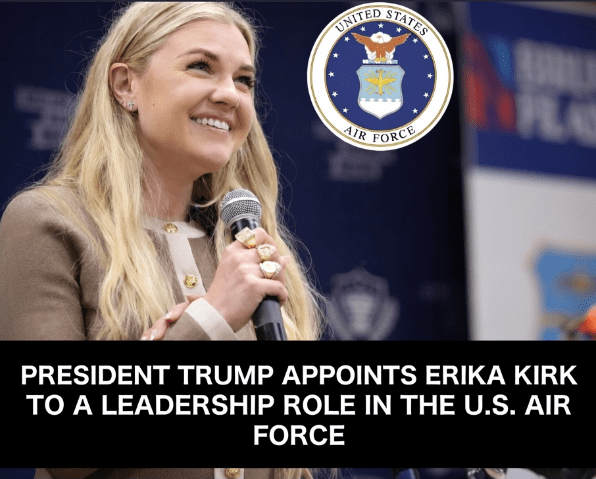
In a move that has taken Washington by surprise and sent social media into an immediate frenzy, President Donald Trump has quietly appointed Erika Kirk — the widow of assassinated conservative activist Charlie Kirk — to the U.S. Air Force Academy’s Board of Visitors. The appointment, which was not formally announced by either the White House or the Academy, only came to light when her name appeared on the board’s official website this week. And from the moment it went public, the reaction has been anything but quiet.
Erika Kirk, 36, is best known to most Americans as the widow of Charlie Kirk, the co-founder of Turning Point USA who was shockingly assassinated on September 10, 2025, while speaking at Utah Valley University. Since her husband’s death, she has stepped into an extraordinary role — taking over as CEO of Turning Point USA, raising their two children, and emerging as a prominent conservative voice in her own right. Now, with this appointment, she is taking on an official government advisory role that puts her at the heart of one of America’s most prestigious military institutions.

The Board of Visitors is a 16-member advisory panel comprising presidential appointees and members of Congress. Its mandate is serious: the board is responsible for examining the morale, discipline, curriculum, instruction, physical equipment, fiscal affairs and academic methods of the Academy, and delivers an annual report to the Secretary of Defense. It is not a ceremonial position — it carries real oversight responsibilities over an institution that trains the next generation of American military officers.
The connection to Charlie Kirk makes the appointment deeply personal. He had been appointed to the same board by President Trump in March 2025 and attended one meeting — on August 7, 2025 — just weeks before his assassination. At that meeting, he pressed the Academy on its compliance with executive orders regarding diversity, equity and inclusion initiatives, and advocated strongly for ensuring that cadets were trained with what he called a genuine appreciation for American exceptionalism. He never got to attend a second meeting. Now, his wife is being asked to continue that work in his place.
The White House has been unambiguous in its enthusiasm for the appointment. “President Trump made the perfect choice in appointing Erika Kirk to the U.S. Air Force Academy Board of Visitors,” White House spokeswoman Olivia Wales said in a statement. “Charlie Kirk served proudly on the Board, inspiring not only the next generation of servicemembers, but millions around the world with his bold Christian faith, defense of the truth, and deep love of country. Erika Kirk will continue his legacy, and will be a fearless advocate for the most elite airpower force in the history of the world whose warriors keep our Nation safe, strong, and free.
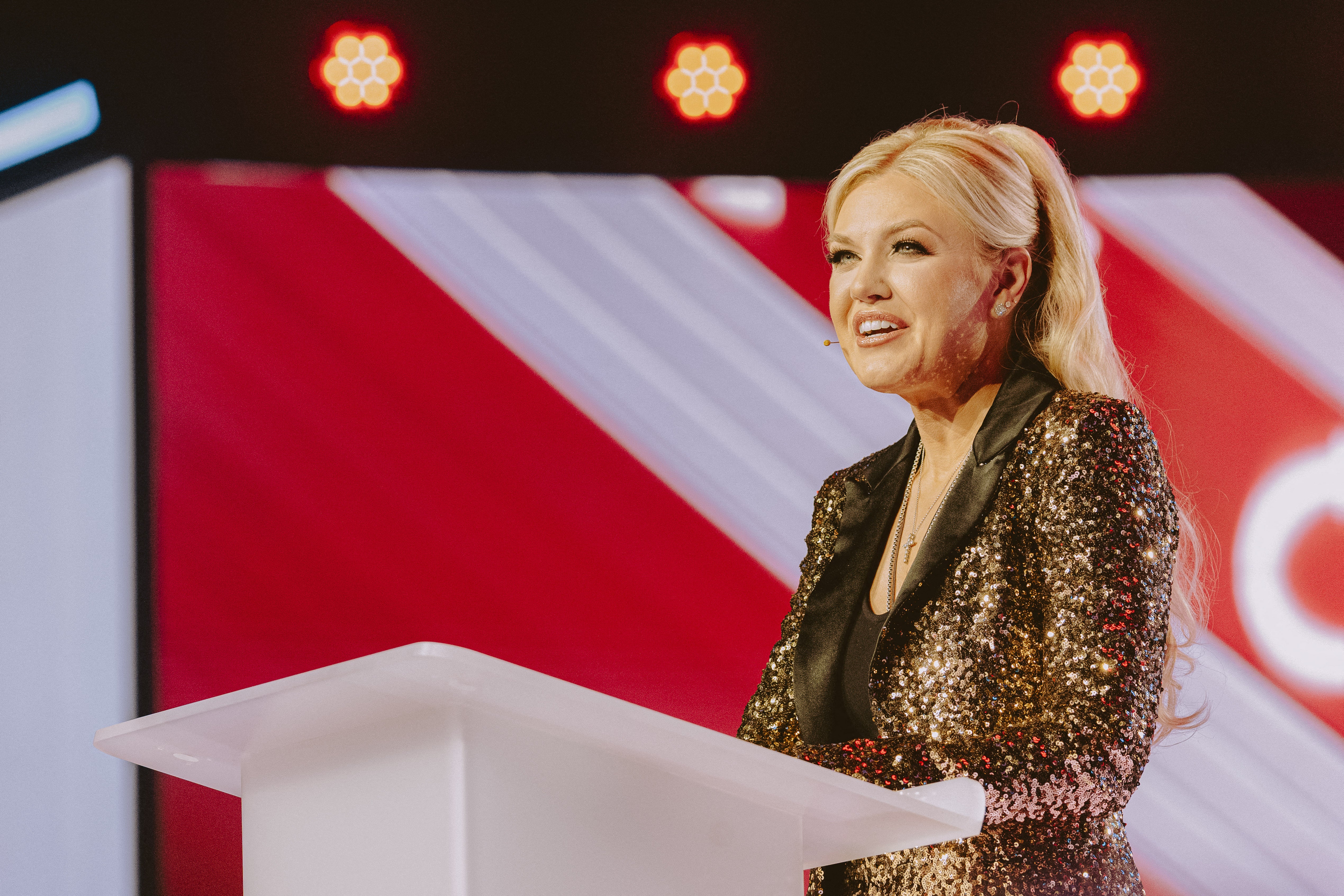
Representative August Pfluger of Texas, a graduate of the Air Force Academy who currently chairs the Board of Visitors, was equally enthusiastic. “I applaud President Trump for appointing Erika Kirk to the U.S. Air Force Academy Board of Visitors,” Pfluger said. “Erika is the right person to fill Charlie’s place on the Board and continue his work of inspiring the next generation of service members.” The congressman noted that he had personally encouraged the appointment and said he looked forward to working alongside her.
But not everyone is applauding. The moment the appointment went public, critics flooded social media with pointed questions about Erika Kirk’s qualifications for a role that typically draws members with backgrounds in military service, defense policy, or higher education administration. Her professional background, which spans nonprofit leadership, political advocacy, pageant competition — she was Miss Arizona 2012 — and conservative media, stands apart from the conventional profiles of board members past and present. She holds a bachelor’s degree in political science from Arizona State University and a Juris Master from Liberty University, and is currently pursuing a doctorate in Biblical Studies.
“What in the actual hell are we doing?” one widely shared post on X read, alongside a photo of Kirk and Trump. Others questioned whether the appointment reflected merit or political loyalty — a debate that has intensified as Trump’s second administration has moved aggressively to reshape the boards of visitors at all five of the nation’s military service academies, installing political allies and conservative figures across multiple panels.

Defenders of the appointment have pushed back firmly on the qualifications argument. They note that the statutory requirements for board membership do not mandate military service or defense policy experience — the board is specifically structured to include civilian perspectives alongside military and governmental ones. They also point to Erika Kirk’s leadership of Turning Point USA as genuinely relevant experience: she now oversees an organization with hundreds of campus chapters, a national political footprint, and significant institutional complexity, having stepped into that role under extraordinary personal circumstances and maintained it effectively.
Laura Loomer, the conservative commentator and Trump ally, addressed critics directly on social media: “Before Charlie Kirk was assassinated in September, he had been selected by President Trump to serve on the Air Force Academy board last year. Erika is the right person to fill Charlie’s place.” The argument — that this is fundamentally a continuation of her husband’s service rather than a standalone appointment — has resonated with many on the political right.
What is beyond dispute is the personal weight this appointment carries for Erika Kirk herself. In the months since her husband’s death, she has spoken publicly and with evident pain about the process of grief, about raising two young children as a widow, and about the decision to step forward into public life rather than retreat from it. She has described her faith as central to her ability to function in the aftermath of an event that would have broken most people. The appointment to the Air Force Academy board — to the specific seat her husband occupied before he was killed — is, for her supporters at least, a profoundly meaningful tribute to a man whose impact on conservative American politics is still being processed.
For the Academy itself, the board continues its oversight work regardless of the controversy surrounding any individual appointment. The institution trains approximately 4,000 cadets at any given time and commissions hundreds of second lieutenants annually into the Air Force and Space Force. The stakes of the board’s oversight — of the culture, academic standards, and leadership development of those future officers — could not be higher. How Erika Kirk chooses to engage with those responsibilities, and what perspective she brings to them, remains to be seen. What is already clear is that her arrival on the board has ensured that the quiet work of military academy oversight has suddenly become anything but quiet.
The appointment has not been formally announced by the Air Force Academy itself, and the White House did not respond to initial questions about the specific timing of the appointment. But Kirk’s name is now on the official list of board members, and that, in Washington, is the only announcement that ultimately matters.